I love how humans have literally not changed throughout history like the graffiti from Pompeii has people from hundreds of years ago writing stuff like “Marcus is gay” “I fucked a girl here” “Julius your mum wishes she was with me” and leonardo da vinci’s assistants drew dicks in their notebooks just for the banter and mozart created a piece called “kiss my ass” so when people wish for ‘today’s generation’ to be like ‘how people used to’ then we’re already there buddy we’ve always been
The Hagia Sophia has inscriptions that were considered sacred for centuries until they were deciphered in the 70s to be Nordic runes saying “Halfdan wrote this”
my old english prof told us that theres a cave in Scandinavia where a viking gratified some runes like 14 feet up on the wall and when they finally reached it all it translated into was “this is very high”
Ancient Shitposting
Now on the History Channel
‘People have literally just always been people’ is genuinely my favorite fact about the world
“Times are bad. Children no longer obey their parents, and everyone is writing a book.” – Marcus Tullius Cicero, 106 BC – 43 BC
so not nearly as old but, this is a 12th century stave church in lom, norway (one of less than 40 left in the world)
it’s hard to see, but in the top left corner of this photo where the light comes in from the window, there’s a runic inscription
these photos show it more clearly, it’s easier to see in person. so of course one of the people i was travelling with asked what it said, and we were told it basically translates to:
“on this day, I climbed to this point, in the corner of the church”
Zanjeer was a Labrador retriever who trained at the Dog Training Center of the Criminal Investigation Department in Pune, India. Following his training, he was enlisted in the Mumbai Police Bonn Detection and Disposal Squad in December of 1992. During his service, Zanjeer helped to recover 11 military bombs, 57 country-made bombs, 175 petrol bombs and 600 detonators. Moreover, he assisted in detecting the bombs during the 1993 Mumbai bombings, averting three more planned attacks.
Due to his outstanding performance, Zanjeer was honoured with a full state funeral after perishing from cancer on the 16th of November, 2000.
The Poison Garden is a public garden full of deadly plants. When the Duchess of Northumberland took over the English garden in 1995, she wanted to fill it with something different that would interest children, who “don’t care that aspirin comes from a bark of a tree. What’s really interesting is to know how a plant kills you, and how the patient dies, and what you feel like before you die.” SourceSource 2
The raven mocker is a monster of Cherokee folklore. In Beyond the Pale they stalk remote forests, preying upon those who get lost within their woods. They draw heavily upon the Cherokee myth and a European creature known as a valravn.
Raven mockers can be used as an excellent threat against players out in the wilderness, able to ratchet up tension as they attempt to move through its territory. Even when they are safe in civilization, a raven mocker faced with cold iron can become a reoccurring threat, even if the party has escaped into an urban environment.
This also marks the first step in improving the presentation of monster lore entries, integrating text and artwork together. Please, like, share and comment on what you think! Beyond the Pale thrives on word of mouth and every bit of exposure helps.
This creature was the winner of the March Wayfarer Patreon Poll. Thank you to everyone who voted!
oxford was built and operational as a college before the rise of the mayans and cleopatra lived in a time nearer to pizza hut’s invention than to the pyramids being built
I need a noncomprehensive history book that covers Known World History in time periods, like “in this century, all this shit was happening concurrently” and not just all spread out so I have to piece it together like some unpaid uneducated scholar
Mongols were fighting Samurai in Japan and Knights in Europe at the same time.
Star Wars a New Hope came out the same year as the last execution in France by Guillotine.
Abraham Lincoln and Edgar Allen Poe were friends in their early 20′s.
When the Great Pyramids were being built there were areas that still had Woolly Mammoths roaming.
Harvard University didn’t teach calculus in its first few years after being established because calculus wasn’t invented yet.
Nintendo was founded two years after the Eiffel Tower was constructed
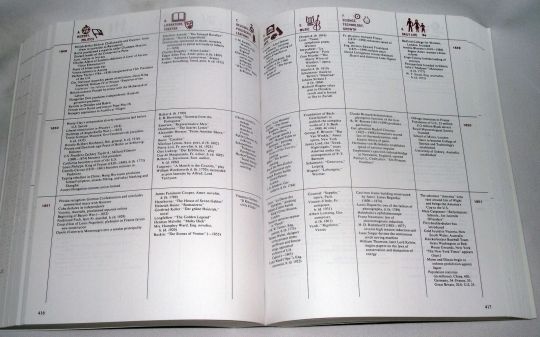
This is the book you want: The Timetables of History – going year by year (or in the earlier sections, at least century by century) and showing you what was going on in various parts of the world in several categories (e.g. Politics, Literature, Science, etc.) Super useful for visualizing what events were happening at the same time.
The serpent’s stone of old, often called a witch’s or hag stone, was said in antiquity to have been made by a mass of snakes whose saliva congealed into a stone with a hole through it, made by the serpent’s tongue. It was said by Pliny that the Druids held it in high esteem. Able to cure disease and quell nightmares, its hollow passage a window through which one might see beyond the veil.
“There is a sort of egg in great repute among the Gauls, of which the Greek writers have made no mention. A vast number of serpents are twisted together in summer, and coiled up in an artificial knot by their saliva and slime; and this is called the serpent’s egg. The druids say that it is tossed in the air with hissings and must be caught in a cloak before it touches the earth.” – Pliny the Elder, in his Natural History
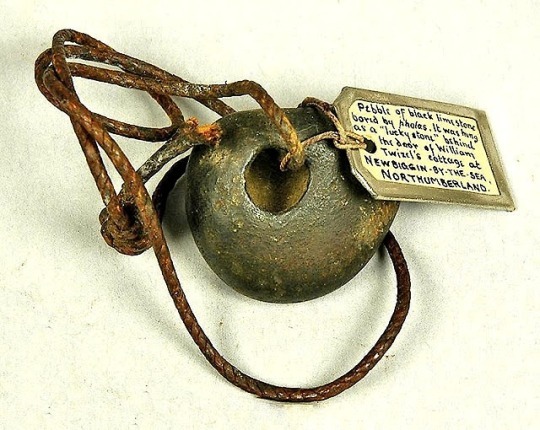
The adder stone takes the name hagstone in the British Isles, and though in Ireland, where there are no serpents to speak of, its origins are more mundane, being simply a stone polished by moving water that wears a hole through its center, its power is none the less extraordinary.
As a ward a hagstone is hung above one’s bed, or even the bed of a farm animal believed to be haunted by night visitors. It is said to quell nightmares and to keep away malefic influences from child and farm animal alike. A common tool of horsemen, cunning craft, and witch alike. The term “hag” in its name comes from the concept of being “ridden” by the night-hag, a once common term for the mora or sleep paralysis.
To those who ride across the hedge the hagstone has other abilities, as a periscope through which we can view the goings on of entities not normally within our visual field. By placing it to the eye it becomes a window into that other realm.
Worn on a cord either around the neck or at the wrist the hagstone is able to influence your dreams beyond just warding away unwanted influences. It is a talisman capable of unlocking the path to the sabbat. In his essay “What is Traditional Craft?” Andrew Chumbley gives a traditional anglian spell used to obtain the journey to the sabbat during self initiation. A simplecord of leather through the stone’s hole and bound to one’s wrist. In this way the hagstone anchors the practitioner into the stream of the other and one ride’s the current that flows naturally toward the sabbat.
Additionally a hagstone can be used to ward the edge of a space, clearing it for ritual use and chasing away whatever boggart or wight may be lurking in the corners.
The history of the use of hagstones goes back millennia, with archaeological evidence of their use in ancient Egypt. They are an incredibly versatile tool, one that travels easily in this modern world as well.
Through their water connection they are particularly useful for weather and sea magics. Their alignment to spirits of water depths and running streams makes them even more of a bridge to that other landscape. Sailors used them in their folkmagic attempts to protect from storms, nailing them to the bow of the ship.
But where does one find one? Can they be purchased? Incidentally, a hagstone is one of the rare items that should ultimately be useful even if purchased/traded from another, as long as it has genuinely been taken from running water when found. Though from the perspective of folkcraft the witch would be advised to go out and find one themselves, a tool found by the witch’s cunning being incredibly more powerful than anything gotten secondhand.
The stones vary in substance, often softer shales and slates making up the easier to find articles along river beds. But as well one might find a hard granite, flint, or quartz stone beaten by the ocean waves along some abandoned beach. The hole must be naturally made by the water’s movement, worn by friction and time.
Hagstones can be incorporated into witches ladders, spirit bindings, ritual clothing, and talismanic objects. They make exceptional ‘worry stones’ that one just carries in their pocket.
The witch’s stone is an incredibly versatile and often overlooked tool in the arsenal of the craft practitioner. While one may have several there is usually a bond with a particular stone that lets it function more personally. Worn on the body or used in a charm an adder stone is practically a must for any witch’s bag of tricks.
Abraham Lincoln was a ‘crazy cat lady’. He regularly took in strays at the White House and was gifted two kittens, Tabby and Dixie, by a cabinet member. He was so in love with the duo that he fed Tabby under the table at a state dinner once and was heard exclaiming, ‘Dixie is smarter than my whole cabinet! And furthermore she doesn’t talk back!’ SourceSource 2
Anyone else feel the Rough Riders weren’t taught enough about in school?
What Really Happened in the Congo: Belgium’s ‘Heart of Darkness’
Leopold famously said when he was forced to hand over the Congo Free State to the Belgian nation: “I will give them my Congo but they have no right to know what I have done there,” and proceeded to burn archives.






 Willow Wisp's Witching Corner